
Week 3 of Lent – Lament as a Way to Return to God
Scripture
“How long, Lord? Will you forget me forever?
How long will you hide your face from me?”
Psalm 13:1
“But I have trusted in your faithful love;
my heart will rejoice in your deliverance.”
Psalm 13:5

Reflection
Psalm 13 begins with a question that feels almost dangerous to say out loud: How long, Lord?
It is the prayer of someone who loves God—but cannot feel Him. Maybe today you are sitting in a situation that is unplanned, unwanted, and deeply hurtful. God doesn’t seem to be anywhere. You can’t sense His presence nor do you hear His voice. I’ve been there. For me it was late one night after giving birth to my third child. Postpartum depression felt like a heavy weight on my heart. It was there I needed God, but where was He?
The psalmist does not tidy his words or rush toward resolution. Instead, he names the ache of absence, the weariness of waiting, and the fear that God may be silent. This is what this space is meant to be….lent is a time before the promise to help turn our hearts to God during our pain.
The goal of Lent, and lament, is not to feel better, but to find God despite our feelings. We do not push the feelings away nor do we idolize them. Our emotions find their proper place with lament. We want to rush ahead and get to the good parts of life, but life doesn’t always feel good. What do we do when we have our questions and doubts?
This time before Easter, before resurrection, can be a time we pause and sit with our feelings. Can I give you permission to grieve what is broken? I want to invite honesty to the table. Instead of trying to be perfect and come to God with perfect faith, let’s allow for imperfect faith.
Lament is not a failure of faith; it is an act of faith. To lament is to keep speaking to God, even when He feels distant. Our minds, our circumstances, and especially our sorrows might tell us
Biblical lament begins with cry or complain, where the psalmist names the pain. Without trying to pretend everything is ok, we turn to God with our pain. We express grief, confusion, fear, or frustration. It is a way to be honest with God. This kind of honesty is not faithless; it is relational, because it chooses to bring what hurts into God’s presence rather than hiding it.
Lament then moves into petition or asking, where the psalmist asks God to act. We see the author asking God to see, to hear, to help, to rescue, or to remember. Even when hope feels lost, asking keeps the relationship alive and affirms that God is still the one we turn to in need. The fact that the author (and us) can come to God and ask means we still have faith God will work.
Finally, lament often ends with trust, not because circumstances have suddenly changed, but because the psalmist chooses to remember who God is. Trust is a way to remember God’s steadfast love, past faithfulness, and saving power. This kind of belief anchors our hope in God’s character rather than in immediate outcomes.
Psalm 13 teaches us how to pray when God feels far away. Notice the movement of the psalm: complaint, petition, trust. It is the perfect picture of Lament. He brings the pain with him into God’s presence. And somehow, in the act of honest prayer, trust begins to grow, not because circumstances change, but because God remains. He does not move away from our pain, but moves towards it.
Lament is a way back to God. It keeps us from turning inward or walking away. When words are raw and hope feels thin, God still listens. Lent reminds us that God is not offended by our questions. He meets us in them.

Prayer
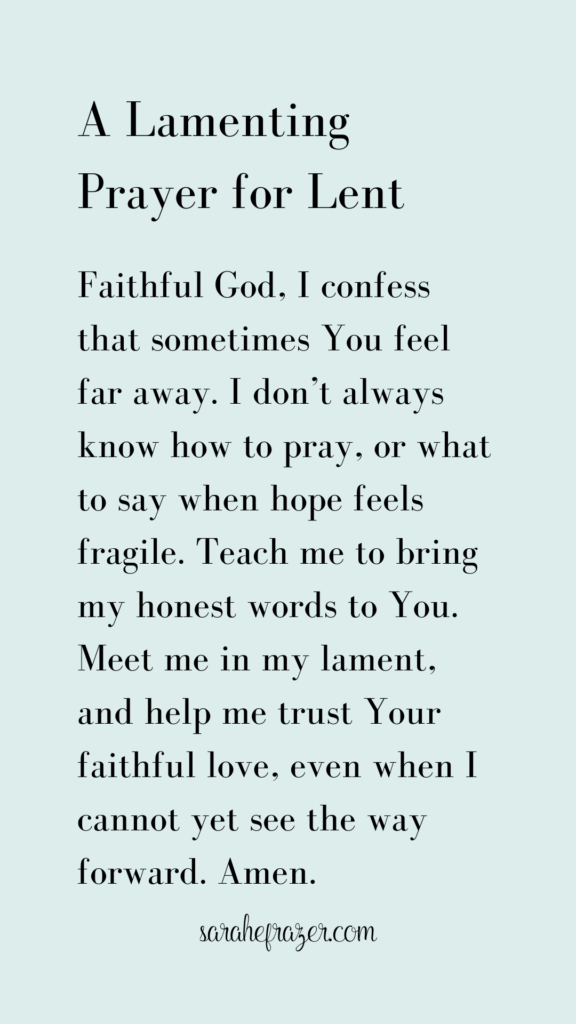
Faithful God, I confess that sometimes You feel far away. I don’t always know how to pray, or what to say when hope feels fragile. Teach me to bring my honest words to You. Meet me in my lament, and help me trust Your faithful love, even when I cannot yet see the way forward. Amen.
Reflective Question
What honest words, or unanswered questions, might God be inviting you to bring to Him this week?
As you consider the movement of lament—complaint, petition, and trust—what words have you been holding back from God, and what might it look like to place those words honestly in His presence this week?
This reflection is part of the Psalms for the Lenten Journey series—a seven-week walk through Lent using the prayers and honesty of the Psalms. If you’d like to read the full series, you can begin at Week 1 and move through each week at your own pace.
Click here to read the other posts in this series.